Why Self-Care Isn’t Selfish: The Science Behind Taking Time for Yourself
There’s a particular kind of guilt that many women know well.
You’ve had a long day. Your back hurts. You’re tired. And somewhere in the back of your mind, there’s a voice saying: you should be doing something else right now. Someone else needs you. This is indulgent.
If that sounds familiar, you’re not alone — and you’re not weak for feeling it. But that voice is wrong. And science has a lot to say about why.
Where the “Self-Care Is Selfish” Myth Comes From
The idea that prioritizing your own needs is somehow self-indulgent is deeply embedded in how many of us — especially women — were raised. Research consistently shows that women are socialized to be caregivers first, with their own needs placed last on the list.
A 2023 study from the American Psychological Association found that women report significantly higher rates of stress than men, yet are also more likely to feel guilty about taking time for themselves. The very people who need rest most are the ones most likely to resist it.
This creates a damaging cycle: high stress leads to physical tension and burnout, but the cultural script says to push through, not pause. The result is chronic stress that compounds over time — and a body that eventually forces you to stop whether you planned to or not.
What Self-Care Actually Is (and Isn’t)
Self-care has been co-opted by marketing into something that means bubble baths and expensive face masks. That’s not what we’re talking about.
Real self-care is any intentional practice that restores your physical, mental, or emotional capacity to function. It’s not a luxury. It’s maintenance.
Think of it this way: you wouldn’t expect your phone to keep running at full capacity without ever being charged. Your body and mind are no different. Self-care is simply recharging — and it’s as necessary as sleep, food, and water.
The World Health Organization defines self-care as “the ability of individuals to promote health, prevent disease, maintain health, and cope with illness.” That’s not a spa day. That’s a survival skill.
The Physiology of Stress — and Why Rest Is Medicine
When you’re under chronic stress, your body operates in a sustained state of low-level fight-or-flight response. Cortisol and adrenaline stay elevated. Your muscles stay tense. Your immune system is suppressed. Your sleep suffers. Your digestion is disrupted.
Over time, this isn’t just uncomfortable — it’s genuinely damaging to your health. Chronic stress has been linked to cardiovascular disease, autoimmune conditions, digestive disorders, chronic pain, anxiety, and depression.
Rest and physical recovery practices — including massage, movement, sleep, and intentional relaxation — directly interrupt this stress cycle. They activate the parasympathetic nervous system (your “rest and digest” mode), lower cortisol, reduce muscle tension, and allow your body to repair itself.
This is not indulgence. This is biology.
Why Physical Self-Care Is Especially Important for Women
Women’s bodies carry stress differently. Research shows that women are more prone to tension-related conditions including:
- Tension headaches and migraines — affecting women at approximately three times the rate of men
- Temporomandibular joint (TMJ) disorders — linked to jaw clenching under stress
- Fibromyalgia — a chronic pain condition affecting predominantly women
- Chronic back and neck pain — exacerbated by stress, poor posture, and carrying the “mental load” of household and caregiving responsibilities
Physical self-care practices — massage, stretching, heat therapy, breathwork — aren’t treating symptoms in isolation. They’re addressing the physical manifestations of stress that accumulate in women’s bodies disproportionately.
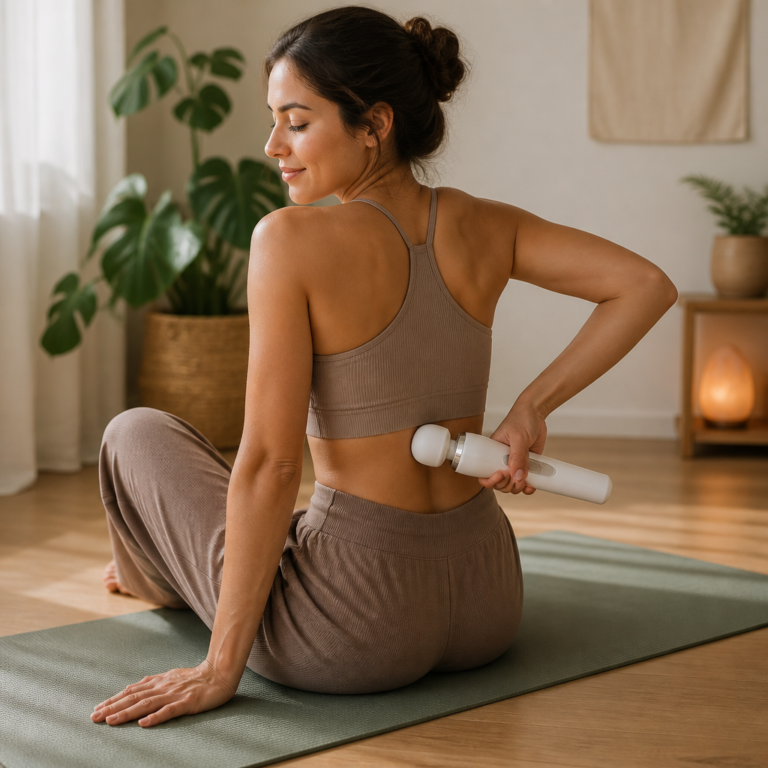
When you take 15 minutes to massage out the tension in your lower back, you’re not being self-indulgent. You’re doing physical therapy on a body that has been absorbing stress on behalf of everyone around you.
The Oxygen Mask Principle — Why You Can’t Pour from an Empty Cup
You’ve heard the airplane safety analogy: put your own oxygen mask on before helping others. It’s repeated so often because it’s genuinely true — and genuinely hard for many people to internalize.
The research on caregiver burnout makes this devastatingly clear. Studies of healthcare workers, parents of children with chronic illness, and sandwich generation adults (those caring for both children and aging parents) consistently show the same pattern: those who neglect their own physical and mental health provide worse care to others over time, not better.
Burnout isn’t a sign of strength. It’s a system failure. And preventing it isn’t selfish — it’s the most responsible thing you can do for the people who depend on you.
Taking care of yourself makes you more present, more patient, more capable. It’s not taking something away from others. It’s investing in your capacity to show up for them.
Small Practices, Real Impact
Self-care doesn’t require a weekend retreat or a significant budget. Research on stress reduction consistently shows that small, consistent practices are more effective than occasional large ones.
Some evidence-backed practices that take 15 minutes or less:
Physical:
- Targeted massage for muscle tension (back, neck, shoulders)
- 10 minutes of gentle stretching or yoga
- A short walk outside — sunlight and movement together are particularly powerful for mood regulation
Mental/emotional:
- Five minutes of intentional breathing (the 4-7-8 technique: inhale 4 counts, hold 7, exhale 8)
- Journaling — even three sentences about what you’re grateful for
- Putting your phone down for 20 minutes before bed
Social:
- Saying no to one thing that drains you this week
- Asking for help with one task you’ve been carrying alone
None of these require money. All of them require the decision to treat your own wellbeing as worth protecting.
Reframing the Narrative
Here’s a reframe worth sitting with: every time you take care of yourself, you are modeling something important.
If you have children, you are showing them that adults take care of their bodies. That rest is not weakness. That women’s needs matter.
If you work with others, you are demonstrating that sustainable performance requires recovery — not just more output.
If you’re your own person making your own choices, you are simply honoring the basic truth that you deserve to feel well.
The guilt isn’t a moral signal. It’s a cultural habit. And like any habit, it can be unlearned.
A Place to Start
If you’ve been putting your own physical wellbeing last, you don’t need to overhaul your entire life this week. You need one small, sustainable practice that you’ll actually do.
Pick something your body has been asking for. The tight shoulders you’ve been ignoring. The lower back that aches by Wednesday every week. The tension headaches that come with every stressful period.
Address one thing. Consistently. Notice what happens.
Self-care isn’t a reward for finishing everything else on your list. It’s what makes the list possible in the first place.
At Velowyn, we believe that women’s physical wellbeing deserves the same attention and care as everyone else’s. Our reviews and guides are written to help you find tools that actually work — so you can take care of yourself with confidence.